Repair·Updated Oct 28, 2026·12 minute read
Repair or Replace Your Gate Operator? The Rule of Thumb We Use
The operator is acting up and someone has to decide whether to fix it or replace it. Retailers will sell you a new one; a repair-only outfit will keep patching. We do both, so here is the rule we actually use, with the numbers.
By Method Doors & Gates · Van Nuys, CA · CSLB #873646
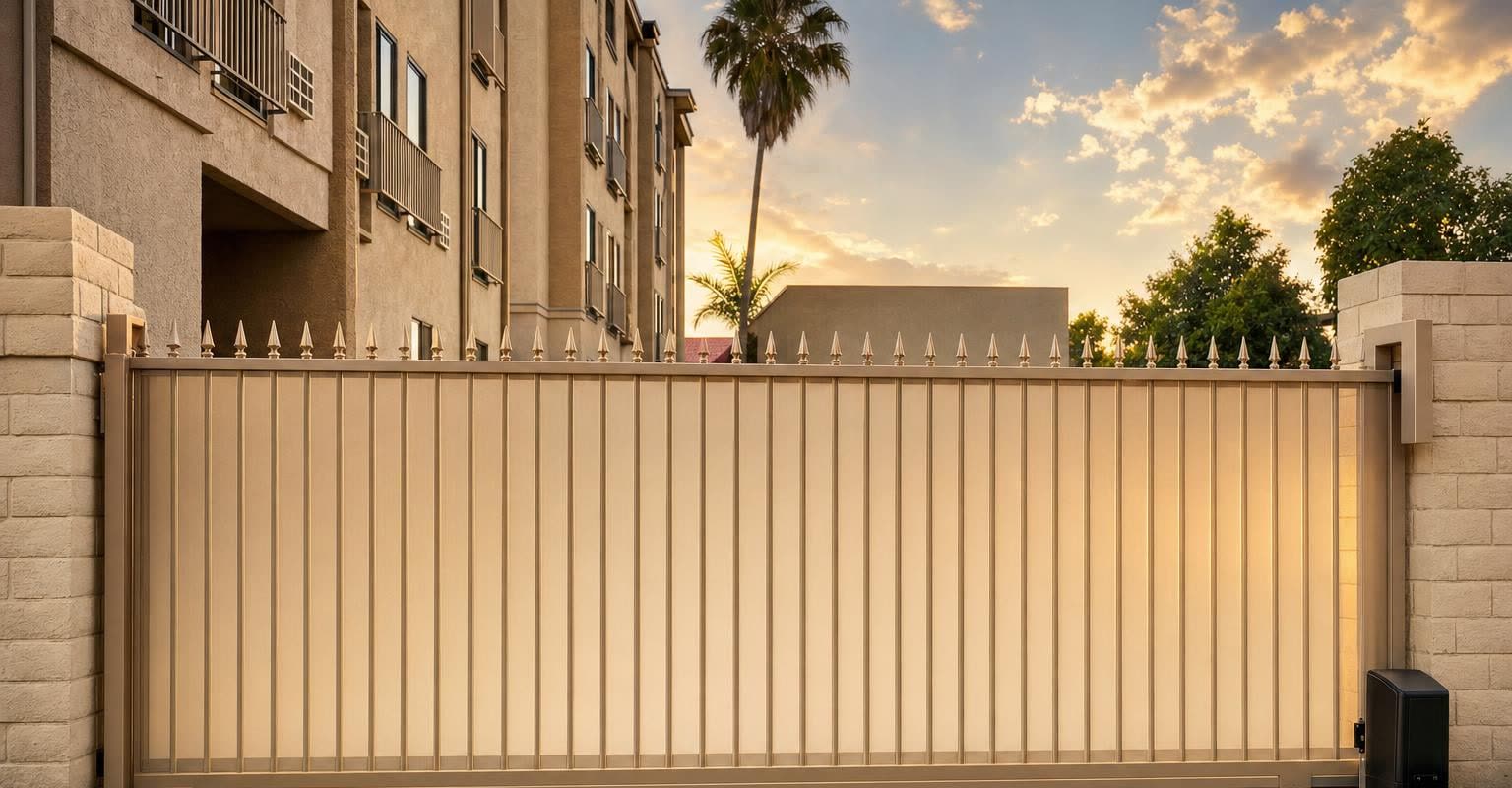
We do both kinds of work — gate and operator repair and operator replacement and upgrades. Here is how we decide between them.
The rule of thumb, in one table
| Situation | Our call | Why |
|---|---|---|
| Under ~10 years old, parts available, first significant fault | Repair | A board, capacitor, limit, or sensor repair, starting at $300 – $2,000, buys years of service |
| Second major repair on the same unit in a short span | Replace | Two big repairs approach the price of a new operator and the third is coming |
| Parts discontinued or on long back-order | Replace | A gate down for weeks waiting on a board is not a repair, it is a gamble |
| Operator undersized for the leaf or the cycle count | Replace with the right class | Repairing an undersized unit fixes the symptom, not the cause |
| Motor, gearbox, or clutch failing on an older unit | Replace | Those are the expensive parts; on an older unit the rest is not far behind |
| Operator made before 2000 | Replace | DASMA recommends it: older units may not accept the entrapment-protection devices required since 2000 |
| Gate binds, sags, or drags | Neither — fix the gate | An operator fighting a bind will fail again whatever you do to it |
What operator repairs cost, and what they fix
Operator repairs, starting at $300 – $2,000, cover the components that fail most and cost least: the capacitor that starts an AC motor (a hum with no movement), the control board or a relay on it (a gate that ignores commands or behaves differently day to day), limit switches or the encoder (a gate that overruns or stops short), photo eyes and safety edges (a gate that won’t close), receivers and antennas (remotes that only work at the gate), and batteries and chargers on DC and solar units. Each is a single-component repair, priced in writing before the work starts.
Capacitors, boards, limits, and gears
A failed start capacitor is the classic cheap fix on a humming AC operator. Boards are more expensive but still well inside the range on most residential units. Limit switches are an adjustment or a small part. A stripped drive gear or a worn clutch sits at the top of the repair range — and on an older unit it is the point where we start talking about replacement, because the motor that stripped the gear is usually tired too.
Batteries and chargers
Backup and solar batteries are consumables. A battery that no longer holds charge, or a charger that has stopped charging it, shows up as a gate that runs slowly, opens but will not close, or dies after a cloudy week. Replacing the battery is routine; replacing the charger is still a repair, not a reason to replace the operator. If the gate stops during an outage, see what happens to an automatic gate in a power outage.
Gate motor replacement cost, and what you keep
“Gate motor replacement” usually means replacing the whole operator — the motor, drive, and controls as one unit. A replacement operator installed starts at $5,000 – $7,000 in Method’s published prices. The spread is mostly the operator: a light residential swing arm sits at the low end; a heavy-duty or high-cycle slide operator with battery backup sits at the top. Safety devices, controls, or gate repairs the new operator needs also affect the price and should be discussed when reviewing the written scope.
A complete replacement quote should cover mounting the operator, aligning the drive to the gate, connecting to the existing power, setting limits and force, programming compatible remotes and keypads, and testing every safety device before the gate goes back into service.
What a new operator requires
A replacement operator is a new product, so it comes with today’s UL 325 requirements even if the old unit did not. Operators made since January 2016 monitor their external entrapment-protection devices — photo eyes, edges, and the like — and will not run automatically if a device is missing or faulted. Manufacturers also specify which sensor brands and models are compatible with each operator. So if the old install never had proper entrapment protection, or its sensors are not on the new operator’s compatible list, budget for new devices as part of the replacement. Every automated gate we install gets the UL 325 and ASTM F2200 safety devices it requires; our UL 325 and ASTM F2200 guide explains what that means for your gate.
What you keep
- The gate, posts, and hinges — if they are sound. A replacement is the moment to fix a sag, not to inherit it.
- Loops and loop wiring — usually reusable if they are intact; the loop detector may need to match the new operator.
- Keypad, intercom, and telephone entry — often reusable if they are compatible with the new operator’s inputs. The quote should say so.
- Remotes — if the new operator’s receiver is compatible; otherwise new remotes or a receiver go on the quote.
- Safety devices — only if they are in good condition and on the new operator’s compatible list.
Age, cycles, and parts availability
Three questions decide most cases. How old is it? Operators do not have an expiry date, but electronics, seals, and gear trains age, and a unit near or past ten years with a major fault is usually a replacement candidate. Age also matters for safety: the Door & Access Systems Manufacturers Association (DASMA) recommends replacing any gate operator made before 2000, because it may not be able to accept entrapment-protection devices.
How hard has it worked? A shared driveway or apartment gate opens for every resident, visitor, and delivery. UL 325 treats those sites as a separate usage class: Class I covers homes of one to four families, Class II covers multifamily buildings and other sites open to the public, and in UL 325’s temperature testing Class II operators are rated for continuous duty while Class I units are tested for limited duty. Can we get the part? If a board or gear set is discontinued or weeks out, we say so and price the replacement instead of leaving you with a gate that is open for a month.
When the gate itself is the problem
Some of what sounds like operator trouble starts at the gate. A leaf that has dropped at the latch side, a seized hinge, flat-spotted slide wheels, or debris in the track all make the operator strain, reverse, and eventually fail. Those are gate repairs, starting at $500 – $4,000, and they have to be done first — otherwise the new operator inherits the same fight. DASMA’s installer guidance says the same thing: make sure the gate works freely and repair worn or damaged hardware before an operator goes on, and never turn up the operator’s force to push a stiff or damaged gate. Our technicians fix the steel, not just the motor.
The troubleshooting guide’s section on sagging and dragging gates covers the symptoms. If the frame itself is failing — rust-through, cracked welds, a leaf never built for its width — our repair cost article explains when to replace the leaf instead.
When we recommend repair
- The fault is a single component and the operator is otherwise healthy.
- The unit is correctly sized for the gate and the cycle count.
- Parts are available now.
- This is the first significant failure.
When we recommend replacement
- The motor, gearbox, or clutch is failing, especially on an older unit.
- It is the second major repair in a short span.
- The operator is undersized — it was never the right class for the leaf.
- Parts are discontinued or the board is a special order with no date.
- It was made before 2000, or the install never had proper safety devices and the operator cannot support them.
Sizing the replacement
The single most useful thing a replacement can do is correct the original sizing mistake. Size it from the gate and the use: the leaf’s weight and length against the manufacturer’s maximums, the daily cycle count, the slope and wind exposure, and the UL 325 usage class the site calls for. DASMA’s guidance for specifiers is the same list — an operator suited to the gate type, size, frequency of use, location, and the people using it. Bigger is not automatically better: DASMA tells installers to set the operator’s force to the minimum that runs the gate reliably.
If you are also thinking about a keypad, intercom, or phone entry, plan it with the replacement, while the controls are being wired anyway — and keep any new keypad or reader at least six feet from the moving gate, as UL 325 requires. For apartment and HOA entrances, our property manager’s guide covers operator class and duty in more detail.
Warranty: what is covered
There are two warranties to ask about, and they cover different things. The manufacturer’s warranty covers the operator and its devices on the terms written for that model; read the document, because conditions differ between manufacturers and models. The installer’s warranty covers the labor and, if the installer built or repaired it, the gate. CSLB, California’s contractor licensing board, advises getting any warranty — the contractor’s or the manufacturer’s — in writing.
Before you approve a replacement, ask how long each warranty lasts, what voids it, and who you call to use it — and get those answers on the written quote.
Questions we hear
- Can I replace just the motor?
- Sometimes. On some operators the motor is a separately serviceable part, and that is a repair. On others the motor, gearbox, and board are effectively one assembly, and by the time the motor is done, replacing the operator makes more sense. We tell you which yours is.
- How long do gate motors last?
- There is no single number. Life depends on whether the operator’s class matches the use (UL 325 temperature-tests Class II units for continuous duty and residential Class I units for limited duty), on how freely the gate runs — DASMA notes a smooth-running gate prolongs the operator’s life — and on maintenance and parts availability. Age matters most for safety: DASMA recommends replacing any operator made before 2000.
- Will a new operator work with my old remotes and keypad?
- Keypads, intercoms, and telephone-entry systems can often be reconnected if they are compatible with the new operator’s inputs. Remotes depend on the receiver; if the new operator uses a different frequency or code format, new remotes go on the estimate. Safety devices must be on the new operator’s compatible list.
- Do I have to upgrade an old operator that still works?
- Not just because the standard changed: DASMA says UL 325 has no retroactivity, and older operators can be repaired. But DASMA recommends replacing operators made before 2000, and a replacement operator comes with current requirements, including monitored safety devices.
- Is a bigger operator better?
- Not by itself. The right operator is the one its manufacturer rates for your gate’s weight and length, in the usage class your site needs, with some margin. DASMA tells installers to set the force to the minimum that runs the gate reliably, and a bigger motor is not a fix for a gate that binds.
- Do you install every brand?
- We service most major residential and commercial operator brands. Ask when you call and we will confirm before the visit.
Sources
- Price basis: Method’s published starting prices — operator repair $300 – $2,000, full operator replacement $5,000 – $7,000, common gate repairs $500 – $4,000. See our pricing page.
- DASMA technical data sheets #356, UL 325 and Gate Installations FAQ (no retroactivity, operators made before 2000, the 2016 changes, Class I and Class II duty testing), #353, Vehicular Gate Operators and the UL 325 Standard (usage classes, monitoring, compatible sensors, control placement), #352, guidelines for installers and end users, and #371, checklist for inspectors and property owners; DASMA’s Gate Systems Safety brochure (monitoring since January 2016; smooth-running gates).
- UL 325, Edition 7 (UL Standards & Engagement; last revised September 15, 2025).
- CSLB: what a home improvement contract should include (warranties in writing).
- Primary references checked October 17, 2026.