Automation·Oct 22, 2026·11 minute read
How Automatic Gate Operators Work: Swing vs Slide Operators, Sizing, Duty Cycle, Solar and Battery Backup
An automatic gate operator is a motor, a drive and a control board matched to one gate, one site and one daily routine. This guide explains the operator types for swing and slide gates, how manufacturers rate them by leaf length, weight and duty, and when solar power and battery backup earn their place.
By Method Doors & Gates · Van Nuys, CA · CSLB #873646
What an operator is made of
Every operator has the same three parts: a motor, a drive that turns the motor’s rotation into gate travel, and a control board that sets the open and closed limits, watches for obstructions, and takes commands from remotes, keypads and safety devices. The motor runs on household AC power or on low-voltage DC; the DC models cited here include battery backup, so they keep running when the mains fail. Several of the sheets list soft start and soft stop, which DASMA describes as easing the gate into motion and slowing it near its limits to spare the drive a shock load. Whatever the type, look for a UL 325 listing, and use only the entrapment protection the operator’s manual names; our UL 325 guide covers both.
Swing gate operators: arm, linear and underground
Swing gate operators come in three forms, and the choice turns on the posts, the look you want, and how far the leaf has to open.
| Type | How it moves the leaf | What it needs | Watch for |
|---|---|---|---|
| Articulated arm | A box on a pad or post drives a two-piece folding arm fixed to the leaf | Room beside the post for the box and the arm’s sweep | The folding arm is a pinch point while it moves |
| Linear actuator | A screw-driven or hydraulic ram pushes and pulls between the post and the leaf | A post and leaf strong enough for the brackets; no concrete pad | A maximum opening angle; one sheet lists 110 degrees |
| Underground | A drive in a steel foundation box set in the ground at the hinge turns the leaf from below | A dug-in box with a sloped drain pipe | Standing water in the box |
The sheets show the trade-offs. One arm operator fixes its arm to the gate’s bottom rail so nothing is welded to the face of the gate, and its maker offers an uphill kit for leaves that swing in an uneven plane. One linear actuator mounts on the gate and post with no pad and opens up to 110 degrees. One underground unit opens to 90 degrees; its installation manual says the leaf must hang entirely on its own hinges, with their pivot lined up over the box’s pivot, and that the box needs a drain pipe at the correct slope, because standing water will eventually make the operator fail. DASMA’s safety guidance warns that a swing operator’s arms may overlap with a scissoring effect, so people stay clear of the mechanism, especially while the gate opens.
Slide gate operators: chain, rack and cantilever
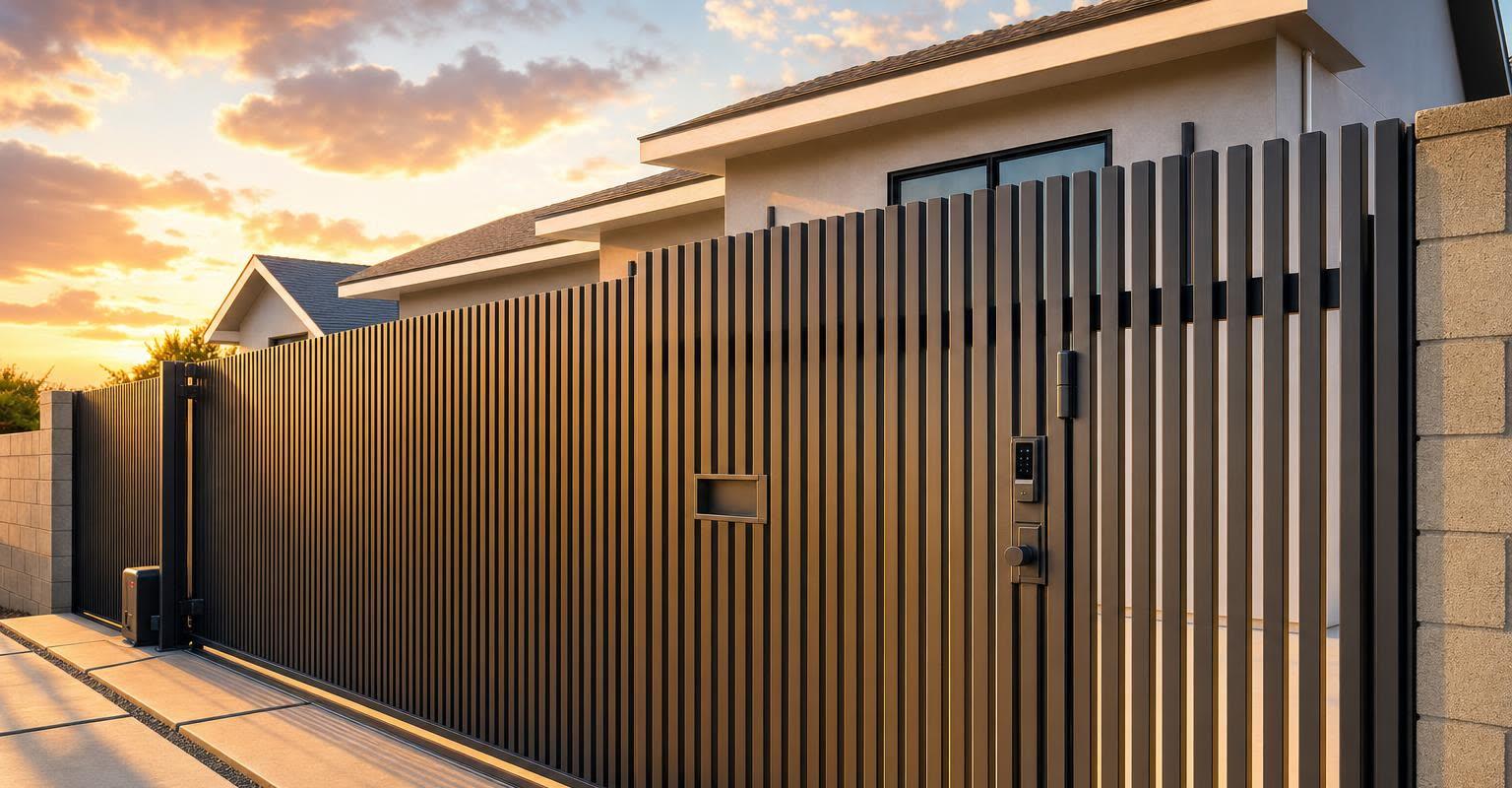
A slide gate operator stands on a pad or post beside the gate and moves the leaf along its track or rollers through one of two drives.
- Chain drive. A roller chain is fixed to both ends of the gate and runs over a sprocket in the operator. One maker ships several slide operators with 20 feet of #40 chain, and its heavy-duty series page rates one model at 2,000 pounds on #50 chain but 3,000 pounds on #60.
- Rack and pinion. A toothed rack is fastened along the gate, and a gear on the operator, the pinion, walks it open and closed. One commercial unit is sold with either a pinion for rack or a sprocket for chain, and the pinion size trades force for speed: with the smaller pinion its sheet lists 4,000 pounds at 38 feet a minute, with the larger one 2,200 pounds at 47.
A cantilever gate is, in DASMA’s definition, a slide gate that spans the opening with no top or bottom support inside it; it is carried on posts beside the opening, with a backframe extending past the first supporting post, and a slide operator drives it like any other slide gate. Two limits apply to all of them. UL 325 caps Class I and II slide gates at one foot per second. And wind can bend a slide gate out of plumb as it travels; DASMA’s rationale for ASTM F2200 says how far depends on surface area, length, construction and the wind itself, too variable for the standard to set a number, so solid infill deserves extra thought. For choosing between the gate types themselves, see sliding vs. swing driveway gates.
Sizing: read the sheet, not the box
Size an operator by checking the gate against the maker’s published limits, because UL 325 has the manufacturer specify the maximum size, weight and drive train an operator is tested with. Those limits move together: one linear actuator’s sheet allows 600 pounds at 18 feet, 800 pounds at 16 feet and 1,600 pounds at 8 feet, so a longer leaf gets a lower weight allowance. The table shows how five published sheets state their limits.
| Operator type | Published limits | UL 325 class | Duty as stated |
|---|---|---|---|
| Articulated-arm swing (sheet A) | Up to 10 ft and 400 lb | Class I | 100 cycles per day |
| Linear swing actuator (sheet B) | 600 lb at 18 ft; 800 lb at 16 ft; 1,600 lb at 8 ft | Classes I and II | Continuous duty |
| Underground swing (sheet C) | Up to 8 ft and 300 lb | Class I | Continuous duty |
| Chain-drive slide (sheet D) | 30 ft and 1,000 lb at ½ hp; 45 ft and 1,500 lb at 1 hp | Classes I to IV | Continuous duty |
| Rack or chain slide (sheet E) | 4,000 lb with the smaller pinion; 2,200 lb with the larger | Classes I to IV | 70% use frequency |
Read the footnotes as closely as the numbers. Sheets A to D assume a gate in good condition, swinging in a level plane or rolling on level ground, and one adds properly adjusted hardware and a warning that other external factors may affect performance. A gate that drags, sags or catches the wind is not the gate the rating describes. DASMA’s installer guidance is to make sure the gate works freely before the operator goes on and to set the force at the lowest setting that runs it reliably, never higher to push a stiff gate. Automating a gate you already have? Our six-point inspection covers what to check first.
Duty cycle and the UL 325 usage classes
Duty is how hard an operator is built to work, and sheets state it in three ways. DASMA defines a cycle as the gate going from fully closed to fully open and back to closed, and duty cycle as the number of cycles per period that an operator is designed to perform. A continuous-duty motor is rated to run continuously under its rated load without overheating; an intermittent-duty operator is a limited-duty unit with a set maximum of cycles per hour. In the table, that reads as 100 cycles per day on the residential arm operator, continuous duty on the commercial slide unit, and a 70% use frequency on the rack-and-pinion unit, a share of running time rather than a count. The same maker’s smallest slide operator is described as for limited-duty residential use only, at 100 cycles a day at most.
The usage class tells you which duty the property needs. UL 325 sorts vehicular gate operators by the property they serve: Class I covers homes of up to four single-family units; Class II covers commercial and public sites, apartments and condominiums of five or more units among them; Class III covers industrial sites the public cannot enter; Class IV covers restricted sites guarded by security staff. Beyond those definitions, DASMA says the standard treats Classes I and II alike except in temperature testing: a Class II operator has to pass it at continuous duty, a Class I operator only at limited duty. Operators are marked with every class they are meant for, and the full class table is in our UL 325 guide. To use any of this, count your own cycles: the trips on a busy day, and the busiest hour where a sheet rates cycles per hour.
Battery backup: rated in cycles
Battery backup keeps a gate cycling through a power failure, and manufacturers rate it in gate cycles, not hours. One DC swing operator’s sheet lists about 40 cycles on its standard batteries and 150 with optional 18 amp-hour batteries, for a 16-foot, 800-pound gate swinging in a level arc, and warns that temperature, the batteries’ state of charge, and the gate’s weight and length all change the figure. DC operators like that one carry their batteries. For the rest of the entrance, one maker offers a 12-volt inverter meant to keep a complete gated access system, phone panel, controller and keypads among it, powered when the mains fail.
Backup is only half of the outage plan. On loss of power, some operators let the leaf be pushed aside by hand and others keep it locked; one slide operator ships with a fail-safe release and offers a fail-secure kit, so the choice is made at installation, within the fire department’s rules for the site. California’s SB 969 battery-backup rule, now Health and Safety Code §19892, applies to home garage door openers; the same chapter defines a garage door in a way that leaves out anything sliding or moving sideways. Our power outage article explains the law and the manual release.
Solar: when it works and when it doesn’t
Solar works when the panel sees direct sun all day, in winter as well as summer, and the gate’s daily cycles and standby draw fit within the maker’s chart. A solar operator runs on batteries the panel recharges, so it comes down to an energy balance:
- Sun hours. One manufacturer’s solar reference guide rates cycles by zone: 6, 4 or 2 hours of sun a day. For one 24-volt linear swing actuator with a 10-watt panel and a small standby draw, its single-gate figure falls from 52 cycles a day at 6 hours to 11 at 2 hours.
- Standby draw. Accessories drain the batteries around the clock. In the same guide, raising the standby draw from 5 to 40 milliamps cuts those 52 cycles to 24 at 6 hours of sun, and the chart gives no figure at all at 2 hours. Another maker notes that only keyed controls draw nothing on standby; keypads, card readers and radio receivers all draw some current.
- Shade, including winter shade. Both makers say the panel must be clear of obstructions and shade for the entire day. One adds that trees and buildings that leave a panel in sun all summer can shade it in winter, when the sun’s path is lower, and that dust on the panel has to be cleaned off.
- Batteries and weather. The same installation manual recommends two 18 amp-hour batteries for up to 60 cycles a day and 35 amp-hour batteries above that. It notes that batteries charge more slowly and give fewer cycles when cold, wear out sooner when hot, and may not recharge fully after several cloudy days in a row.
That makes solar a reasonable fit for a gate far from power, with modest traffic and low-draw controls, and a poor one for a busy gate, a shaded lot, or a panel expected to feed power-hungry accessories as well. Where the alternative is trenching a power line, our gate opener installation page covers the power options for a gate you already have.
Safety devices come with the choice
Choosing an operator also chooses its safety devices. Under UL 325 every entrapment zone gets two independent forms of protection, the operator monitors its external photo eyes and edges, and each manufacturer names the external sensors compatible with its operators, so the eyes and edges come from the new operator’s manual, not from the old installation. Several sheets cited here say the operator will not run without them connected. For the zones, the devices, and the gate upgrades that automation brings, slide-gate screening included, read our gate safety standards guide.
Questions we hear
- What size gate opener do I need?
- One whose published limits cover your gate’s length and weight together, whose duty rating covers your busiest day, and whose UL 325 class matches the property. Where a swing operator’s sheet charts length against weight, the allowance falls as the leaf gets longer, so read the figure at your gate’s length, not the headline maximum. The gate also has to move freely by hand before any operator goes on.
- What does duty cycle mean on a gate operator?
- It is the number of open-and-close cycles an operator is designed to make in a given period. Sheets give it as cycles per day or per hour, as a percentage of running time, or as continuous duty, meaning the motor can run under its rated load without overheating. UL 325 tests Class II operators for continuous duty and Class I for limited duty.
- Is an underground gate operator a good idea?
- It hides the drive, which suits a gate where nothing should show, but it needs a foundation box dug in at the hinge and a drain pipe sloped away from it; one maker’s manual says standing water in the box will eventually make the operator fail. The underground unit cited here is rated for residential leaves up to 8 feet and 300 pounds and opens to 90 degrees.
- Will a solar gate opener keep up with my gate?
- It will if the panel gets sun all day in every season and your daily cycles and accessories fit the maker’s chart for that panel and battery. In one manufacturer’s guide, the same operator falls from 52 cycles a day with 6 hours of sun to 11 with 2 hours, and further still when accessories draw more current on standby.
- How long does gate battery backup last?
- Manufacturers rate it in cycles. One DC swing operator’s sheet gives about 40 cycles on its standard batteries and 150 with larger ones, for a 16-foot, 800-pound gate, and says cold, partly charged batteries and a heavier or longer gate reduce that. Ask for the figure for your own model and gate, and have the batteries checked at each service.
- Does California require battery backup on gate operators?
- Not under SB 969. The battery-backup rule it created covers home garage door openers, and the Health and Safety Code chapter it sits in defines a garage door to exclude anything that slides or moves sideways. Gates on required fire-access routes follow the fire department’s own rules for power failure. Our power outage article walks through the statute.
Sources
- DASMA: TDS 350, operator terminology: cycle, duty cycle, continuous and intermittent duty, actuator, harmonic arm, soft start and soft stop, cantilever slide gate and backframe, battery back-up, fail safe and fail secure.
- DASMA: TDS 353, gate operators and UL 325 and TDS 356, UL 325 FAQ: the four usage classes, marking every intended class, the one-foot-per-second limit on Class I and II slide gates, makers specifying maximum size, weight and drive train, limited versus continuous duty in temperature testing, and compatible external sensors.
- DASMA: TDS 352, guidelines for specifiers, installers and end users: an operator suited to the gate’s type, size, frequency of use, location and users; a gate that works freely before the operator goes on; minimum force; the scissoring arm hazard. TDS 370, rationale behind ASTM F2200: wind bending a moving slide gate.
- Sheet A: DoorKing 6050 cut sheet (Rev. 6/22), with the swing operator brochure (Rev. 2/23): two-piece articulating arm on the bottom rail, uphill kit, 10 ft and 400 lb, Class I, 100 cycles per day, the good-condition and level-plane footnote; the whole-system inverter.
- Sheet B: DoorKing 6006 actuator cut sheet (Rev. 2/21): screw drive mounted on gate and post with no concrete pad, 110-degree maximum opening, the three weight and length pairs, Classes I and II, continuous duty, no running without entrapment protection.
- Sheet C: DoorKing 6400 in-ground cut sheet (Rev. 3/21) and 6400 installation manual: foundation box, 90-degree opening, 8 ft and 300 lb, Class I; the leaf carried on its own hinges with their pivot aligned over the box, the sloped drain pipe and standing water.
- Sheet D: DoorKing 9150 cut sheet (Rev. 11/20), slide operator brochure and 9200 series page: #40 chain, limits by horsepower, Classes I to IV, continuous duty, fail-safe release with a fail-secure kit, the limited-duty 100-cycle residential model, ratings by chain size.
- Sheet E: FAAC 844 ER specification sheet (2016, copy hosted by a dealer): pinion for rack or sprocket for chain, the two pinions’ weights and speeds, 70% use frequency, Classes I to IV.
- DoorKing: 6524 DC swing operator sheet (Rev. 6/20): built-in battery backup, about 40 and 150 cycles by battery size, and the conditions behind them.
- Solar: LiftMaster Solar Gate Cycles per Day Reference Guide (2014, copy hosted by a dealer): zones of 6, 4 and 2 sun hours, cycles by panel, battery and standby draw, shade and cleaning. DoorKing solar control box manual 4302-067 and solar page: all-day sun, winter shadows, dust, battery size by daily cycles, temperature and cloud effects, standby draw of accessories.
- California Health and Safety Code §19892 and §19890 (FindLaw mirror, current as of January 1, 2026): the battery-backup requirement for home garage door openers from July 1, 2019, and the garage door definition that excludes sliding or horizontal structures.
- All sources read October 22, 2026. Figures belong to the models named; the manual for the operator on your gate governs.
Read next
- Keypad, Remote, Intercom, Phone Entry or App? Choosing Gate Access Control for a Home or a Managed Property
- Can You Automate an Existing Driveway Gate? Our 6-Point Inspection
- UL 325 and ASTM F2200 Explained: What a Safe, Compliant Automatic Gate Includes
- What Happens to an Automatic Gate in a Power Outage? Battery Backup, Manual Release and What SB 969 Does (and Doesn't) Cover