Cost·Updated Oct 28, 2026·9 minute read
Repair or Replace Your Garage Door? How to Decide
Every repair call on an older garage door ends with the same question: is this worth fixing? We repair doors and install them, so we have no stake in the answer. Here is the rule we use, the faults worth repairing, the ones that mean a new door, and what a replacement quote should spell out.
By Method Doors & Gates · Van Nuys, CA · CSLB #873646
Repairs that are worth making
Most of what goes wrong with a garage door is a wear part, and a wear part is not a reason to replace the door. Springs break on schedule — rated in cycles, as our spring guide explains — and a broken spring on a sound door is a spring replacement, not a verdict on the door. Cables fray, rollers wear flat or seize, hinges crack; all are standard parts for a door of any age, provided the sections they bolt to are straight. DASMA’s advice for an older door is to have the springs inspected and replaced if needed — a service visit, not a replacement.
The opener fails on its own schedule, so its decision is made separately; a new opener on an old door is normal. One damaged panel on a current model is a repair when the manufacturer still makes the section — Clopay says replacement is likely feasible when damage is confined to one or two panels, and Amarr’s guidance is the same. Garage door repair covers all of it with a written price before work starts.
What tips the decision to a new door
A door is replaced when the problem is the door rather than a part on it:
- Several bent or creased sections. Amarr suggests replacing the door when more than two panels have serious damage; Clopay says major damage across multiple panels makes full replacement the more cost-effective option.
- A discontinued panel. Clopay supplies replacement sections only while it still makes the model; once a pattern, window design or colour is dropped, a near-match on a street-facing door is a new door bought in instalments.
- Rust or rot in the structure. Surface rust on a bottom section can be treated; rust through the skin, or rot that has softened a wood door’s rails, has taken the structure, and DASMA’s checklist treats panels showing fatigue, cracking or separation of materials as a hazard for a technician to assess.
- A bowed or split wood door. A door that no longer sits flat in its tracks binds on every cycle, and a split rail will not hold hinge screws; we rebuild single wood sections, but a door that has moved as a whole is replaced as a whole.
- A door hit at the track line. A car backing into the bottom section often bends the track, the bottom bracket and the section together; Clopay says a dent that disrupts structural integrity or interferes with the track may not be repairable to full strength.
- Repeated failures. A spring, then a cable, then a section inside a year or two means the next repair is spent on a door with the following failure still in it; Amarr notes that repairs on older doors often cost more than new ones.
None of this is about age alone — a twenty-year-old steel door with straight sections and new springs is sound — though Clopay puts the usual tipping point at around fifteen years, when replacement panels stop being available.
Panels: when a section can be matched, and when it cannot
One section can be swapped if a match exists, and three things have to line up. The model must still be in production: Clopay supplies sections only while it makes the model, identified from the serial number inside the bottom section on doors built in the last ten years. The construction must match — thickness, insulation, embossing, windows — since an insulated section neither sits flush beside uninsulated ones nor weighs what the springs were sized for. And the colour must be close: both manufacturers warn a new section can read a shade off beside a sun-faded door, though a panel can sometimes be painted to blend in.
When all three line up, panel replacement is the right call and the cheaper one. When the model is discontinued, the choices are a near-match, a repair to the damaged section, or a new door — and on a door the street sees, a visibly different panel is not a repair but a new problem; Amarr notes the cost gap between a panel and a full door shrinks quickly once the door is older or more than one panel is involved.
Keeping the opener, and when it should go with the door
An opener carries over when it is in good order and current. Clopay’s FAQ says just about any opener can be installed with a new door, on two conditions: confirm with its manufacturer that it meets current safety standards, and reinforce the top section before the arm is attached. The motor, rail and controls carry over; the bracket, strut, travel and force are set up again for the new door, and the reversal test is run on it.
Replace the opener with the door when:
- It has no photo eyes. DASMA’s checklist notes that federal law requires residential operators manufactured after 1992 to have photoelectric sensors or another UL 325 safety-reverse feature, and says an operator without entrapment protection should be replaced.
- It has no battery backup. California’s SB 969 requires battery backup on residential openers sold or installed in the state; our power-outage guide explains the statute, and opener installation covers the replacement.
- It is old or already failing. One that strained for years against an out-of-balance door, or that hums, hesitates or needed its force turned up, is replaced rather than reconnected.
- It no longer suits the door. A heavier or taller door or a different track configuration can change what the opener needs; we check at the measurement.
Springs never carry over: the new door has a new weight, and DASMA says a spring applied to the wrong door shortens the life of the door and the motor and makes manual operation unsafe. New springs sized to the new door, and usually new track, are part of the job.
Insulation: what an R-value means, and when it matters in LA
An R-value measures resistance to heat flow; higher resists more. Clopay’s guide puts a non-insulated door near R-0, a polystyrene door at about R-6 to R-9, and its polyurethane doors between R-6.3 and R-20.4 by model. One caution from the same manufacturer: a published R-value usually describes the insulation inside a section, not the whole installed door, so ask for the construction — single, double or triple layer, polystyrene or polyurethane — not the number alone.
Where insulation earns its place in Los Angeles is not the climate; it is the house. For an attached garage sharing a wall with living space, Clopay recommends R-12 to R-18. A room above the garage sits on what Clopay calls an energy sink when the garage swings in temperature. Noise matters under a bedroom: Clopay’s own test measured a polystyrene door at 96 decibels and a polyurethane door at 80. A detached garage used for parking gets none of that; a non-insulated door is the honest recommendation there. We make no claim about what it saves on a bill.
What a replacement quote should itemise
A replacement quote should be comparable with another bid and with the repair it replaces. Ask that it name:
- The door: manufacturer, model, material, thickness, insulation type and R-value, colour, windows and hardware.
- Springs sized to the new door, with the cycle rating and whether it is one spring or two.
- Track and hardware: new track, rollers, hinges, bottom brackets and any struts; Amarr notes a new door’s weight can call for all-new track.
- Weather seal: the bottom seal and the jamb and header seals.
- The opener: reused, with its reversal test, or replaced, with the model and battery backup stated.
- Removal and haul-away of the old door, springs and track.
- Permit: we tell you at the measurement if one applies; changing the size of the opening or re-framing is a different job from a same-size change-out.
- The price in writing, with the repair alternative beside it when there is one.
A quote should not be priced from a photograph: width, height, headroom, side room and backroom, plus a look at the framing and the opener, decide what fits, and garage door installation explains the visit.
Custom or standard?
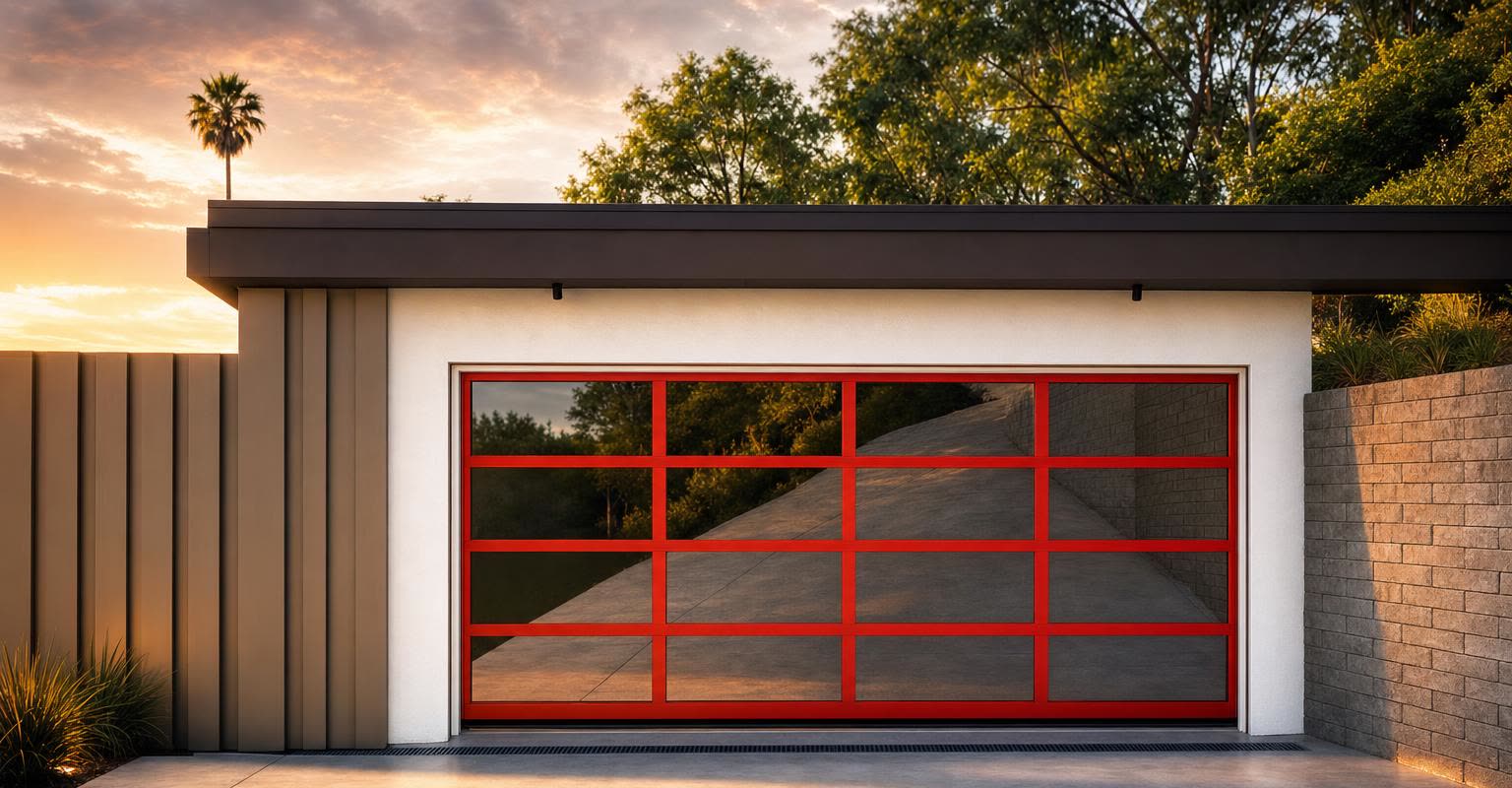
A manufacturer door covers most replacements — steel, insulated steel, wood-look composite, carriage-style and full-view glass — and garage door installation is that service. Choose a custom door when the opening is an odd size, when no catalogue carries the material or pattern the house wants, or when the door should match the driveway gate — the two largest objects on the street face of a house; our design guide covers matching them to the architecture. Custom garage doors are built to our drawing, which you approve first.
Questions we hear
- Is it cheaper to repair or replace a garage door?
- A single repair is almost always cheaper than a door. The comparison that matters is the repair against the repairs still to come: a worn part on a sound door is fixed once, while several damaged sections, a discontinued panel or rust in the structure keep generating repairs. We quote both and say which we would choose.
- Can I replace just one panel?
- Yes, when the model is still made, the section matches the door’s construction and the colour will be close; Clopay and Amarr both put one or two damaged sections in panel territory. A discontinued model or a faded finish turns it into a near-match, which on a street-facing door usually argues for a new door; see panel replacement.
- Can I keep my opener when I replace the door?
- If it has photo eyes and battery backup and works properly, usually yes; Clopay says just about any opener can be installed with a new door once the top section is reinforced. Without sensors, DASMA says replace it; without battery backup, SB 969 applies; a tired opener is replaced with the door.
- Does an insulated garage door pay for itself?
- We do not make that claim, and nobody can without measuring your house. What an insulated door does, per Clopay, is steady the temperature of an attached garage or a room above it, cut the door’s noise and stiffen the sections; for a detached garage used for parking, a non-insulated door is the right buy.
- How long does a garage door last?
- Amarr puts a maintained door at around thirty years, with springs, cables, rollers and the opener replaced along the way; the door itself is finished when its sections, track line or structure go. Our troubleshooting guide covers the checks that are safe to make before you call.
Sources
- Clopay: can I replace my garage door panels? (September 2016: one or two panels, the fifteen-year point, serial number location, multiple-panel damage, damage reaching the frame); should I repair or replace a dented garage door? (October 2025: dent depth and location, structural integrity and the track, discontinued models, colour match, paint to blend); garage door FAQ (sections available while the model is made, openers with new doors, reinforcement before attaching an opener).
- Clopay: insulated vs non-insulated garage doors (R-value definition, R-0, R-6 to R-9, R-6.3 to R-20.4, attached garages, rooms above, the 96 vs 80 decibel test, dent resistance); R-value vs U-factor (August 2026: calculated section R-value vs whole-door performance, R-12 to R-18 for attached garages, the room above as an energy sink); garage door components guide (struts, hinges, rollers, cables and drums).
- Amarr: garage door replacement panels: when to repair or replace (September 12, 2023: one or two sections, more than two panels, discontinued type, style or colour, fading, mechanical integrity, the ten-to-fifteen-year window); garage door repair vs garage door replacement (doors over fifteen years, around thirty years with maintenance, older-door repairs costing more than new doors, new track for a new door’s weight).
- DASMA: TDS 167, residential sectional garage door and electric operator checklist (panels showing fatigue, cracking or separation; operators manufactured after 1992 and photoelectric sensors; replace an operator without entrapment protection; operator reinforcement; the balance test); TDS 190, factors affecting spring cycle life (a spring applied to the wrong door); garage door safety tips (older doors: springs inspected and replaced if needed).
- U.S. Consumer Product Safety Commission, 16 CFR Part 1211, Safety Standard for Automatic Residential Garage Door Operators (2025 edition, govinfo): applies to operators manufactured on or after January 1, 1993; the required instructions to install only a properly balanced door and to have a qualified service person repair cables and spring assemblies before installing the opener.
- Primary sources read October 21, 2026. California’s battery-backup law (SB 969) is covered, with the statute, in our power-outage guide; permit requirements vary by city and are confirmed at the measurement.