Design·Updated Oct 22, 2026·11 minute read
Gates for Steep and Sloped Los Angeles Driveways: Swing, Slide, or Bi-Fold?
On a hillside lot, the slope at the gate line decides the gate before style does. Here is how to read a sloped driveway, which gate types work on one, and what changes for operators, safety devices and permits on a grade.
By Method Doors & Gates · Van Nuys, CA · CSLB #873646

The short answer, by slope
A hillside gate starts the way every driveway gate we build does: a survey, then a scaled drawing. What the survey finds at the gate line points to one of these:
| What the driveway does at the gate line | Usual answer | Why |
|---|---|---|
| Flat for at least the leaf’s width behind the gate | Swing gate (single or double) | The leaf opens over level ground |
| Rises gently behind the gate | A level pad, a slide, or rising hinges on a manual gate | A lifted leaf wants to swing shut, which is a problem on an automated gate |
| Rises steeply right behind the gate | Slide or cantilever along the fence line | The leaf moves sideways and never enters the driveway |
| Falls away behind the gate | Swing inward can work; check the gap under the leaf | A 4–16 inch gap under a swing leaf changes where contact sensors go |
| Gate at the sidewalk, rising drive, no run-off | Bi-fold, or set the gate back to a level pad | A bi-fold needs far less depth; setting back can create the pad a swing needs |
| Cross-slope (the drive tilts sideways at the gate) | Cantilever, or a track gate on a leveled track | A track must be level; a cantilever rides on rollers mounted to posts |
Why swing gates fight slopes, and three ways around it
A swing gate’s bottom rail travels in a flat arc. If the ground inside that arc rises, the leaf hits it before it’s open. There are three ways around that, and each has a catch.
Rising hinges or a raised leaf
Rising hinges lift the leaf as it swings so it can follow a gentle rise; each model is rated for a limited slope and gate weight. The catch is gravity: a lifted leaf wants to swing back down. ASTM F2200, as DASMA’s rationale explains it, says an automated gate shouldn’t start moving under gravity when it’s disconnected from its operator, and one rising-hinge maker warns that a gate released from its automation will fall under gravity. That makes rising hinges best suited to manual gates or small corrections. The other trick is hanging the leaf higher and filling the gap below with a fixed panel. On an automated swing gate, DASMA’s summary of UL 325 adds the bottom edge to the places a contact sensor goes wherever the gap under the leaf is more than 4 but less than 16 inches during its swing.
Swinging the other way
If the drive rises inward, a gate can sometimes swing outward instead, but only if the open leaf stays on your property. In the City of Los Angeles, the Bureau of Engineering treats anything projecting into the public right-of-way below 8 feet as prohibited unless the building code lists it (steps, certain architectural features, awnings); anything else is an unallowable projection that may need a revocable permit and a Board report. A gate leaf isn’t on the list. LADBS also cautions that the inside edge of the sidewalk isn’t necessarily the property line, so confirm where the line is before the swing direction is drawn.
A level pad at the gate line
Sometimes the right fix is to the driveway: a level pad the depth of the leaf, held by a low retaining wall, turns a slope problem into an ordinary swing gate. It adds concrete work and can add permits. LADBS publishes a standard detail for a short retaining wall with level ground behind it that needs no building permit, but that detail can’t be used where the existing slope is steeper than 1 vertical to 5 horizontal (20 percent), and walls holding back sloping ground need a permit. Where the wall work is extensive, LADBS says to consult a licensed civil or structural engineer.
Sliding and cantilever gates on hills
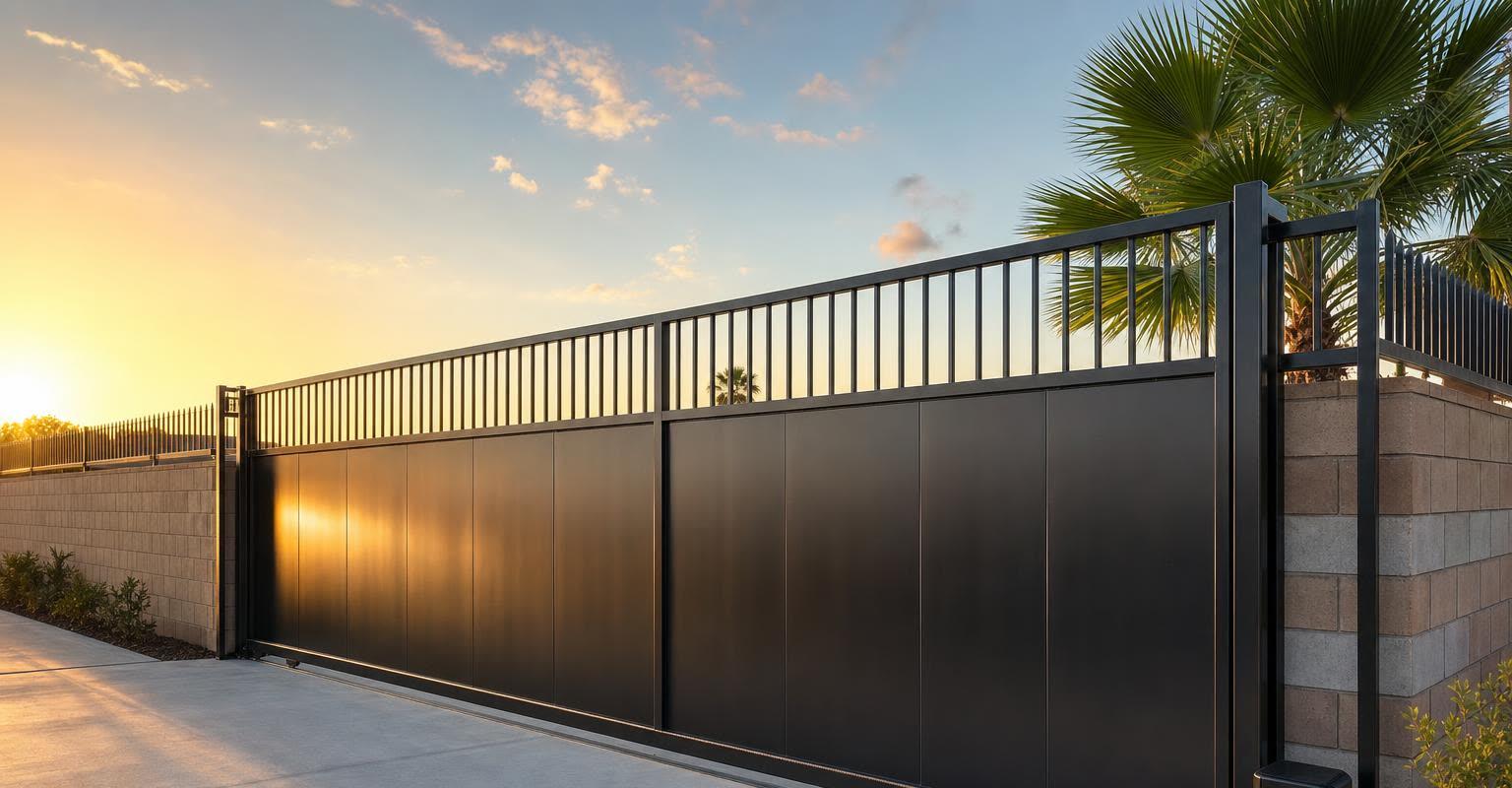
A slide gate moves along the fence line instead of into the driveway, so the slope behind the gate doesn’t matter; the run along the fence does. A track gate rolls on wheels along a track set in the driveway, and that track has to be level and straight. On a sloped track the gate would roll downhill once released, which is exactly what the gravity rule in ASTM F2200 is meant to prevent. A cantilever gate hangs from rollers on posts beside the opening and never touches the ground, so the surface under it can be uneven as long as the leaf clears it. The trade-offs: its counterbalance section extends past the opening, so it needs a longer clear run than a track gate, and its posts and footings carry the whole leaf. Sliding vs. Swing Driveway Gate compares the two.
Automated slide gates carry construction rules of their own, summarized by DASMA: exposed weight-bearing rollers below 8 feet must be guarded, positive stops keep the leaf from running past its supports, and openings from the bottom of the gate to at least 6 feet must be small enough to stop a 2¼-inch sphere, including the fence section the gate covers when open.
Bi-fold and vertical options for tight hillside pads
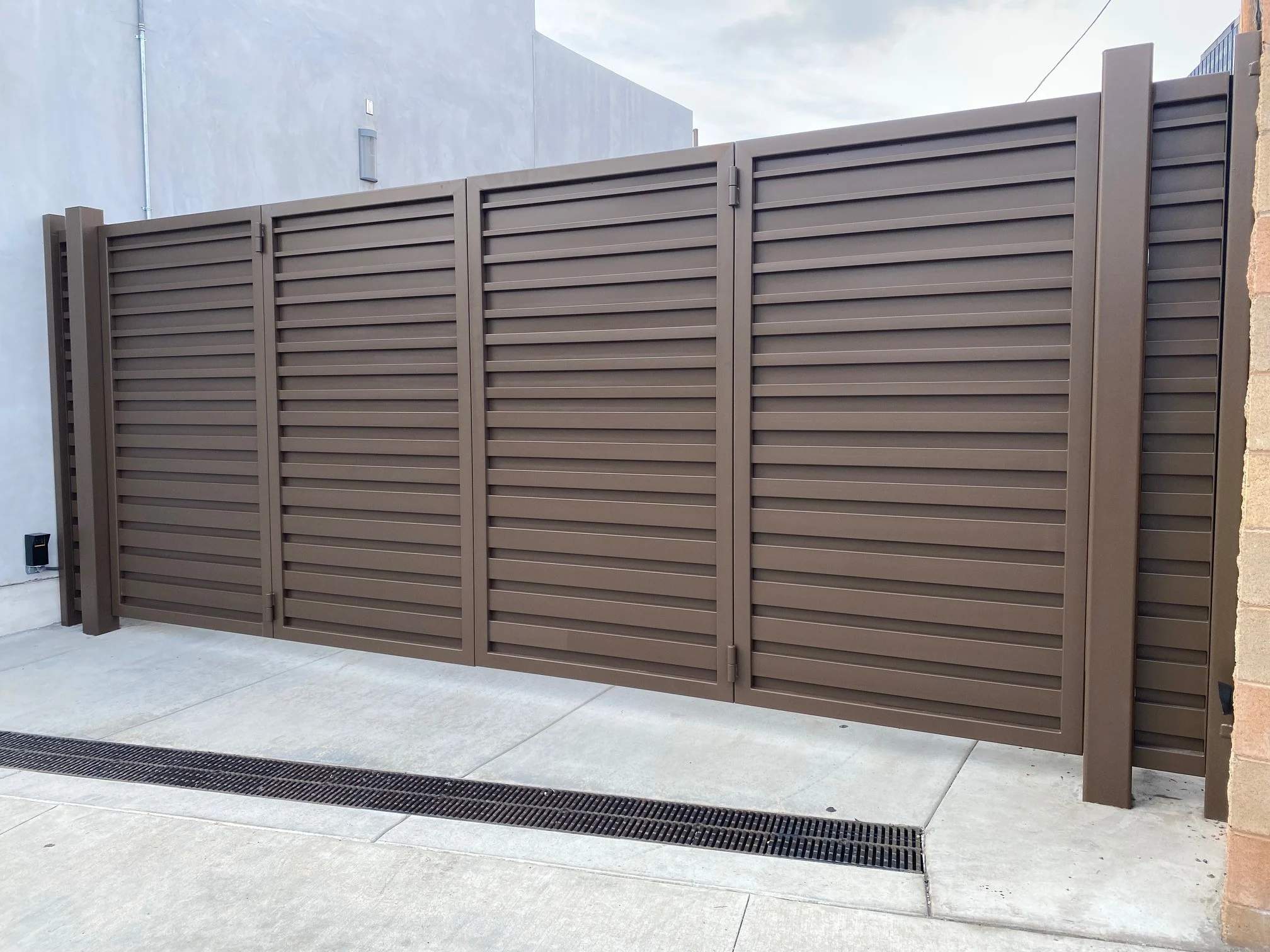
Some hillside lots have neither the depth for a swing nor the fence run for a slide: a gate at the sidewalk, a retaining wall on one side, a neighbor’s wall on the other. A bi-fold gate splits each leaf into panels that fold as they open, so it needs far less depth than a swing. It means more hinges and a more careful build, and ASTM F2200 treats it as a gate type of its own. Vertical lift and vertical pivot gates, also covered by the standard, solve the same space problem but need clearance above the opening; ask whether your site suits one.
Operators, safety devices and power on a grade
Slope changes what the operator works against. If a leaf’s hinges or track aren’t level, gravity helps the gate one way and fights it the other. The operator has to be rated for the gate’s size and weight within the manufacturer’s limits, its force set to the lowest setting that runs the gate reliably, and its sensors placed where the leaf actually travels. UL 325 calls for non-contact sensors wherever there’s a risk of entrapment or obstruction, and DASMA notes that only the installed gate shows where those areas are; on a slope they may not be where a flat-lot layout would put them. Each entrapment zone gets two independent means of protection, as UL 325 requires. Our UL 325 and ASTM F2200 safety guide explains the device rules, and our automatic gates page covers operators.
Power deserves a plan too: how the gate behaves in an outage, whether battery backup makes sense, and how it opens by hand. What to do when an automatic gate loses power covers it.
On a sloped site, don’t release a gate from its operator until the installer has shown you how your gate behaves once released; a released leaf can swing or roll on its own. Keep clear of its path, and never force a gate that won’t move.
Hillside permits and LADBS review
Many hillside neighborhoods, including Encino, Sherman Oaks, Studio City, Bel Air, Brentwood and the Palisades, are inside the City of Los Angeles, so the permit desk is LADBS; its limits by yard and zone are in the permit guide’s height table. In a hillside area, side and rear fences stop at 6 feet however wide the lot is (LADBS’s fence answers tie this to the City’s Special Grading Area), and on sloping ground the bulletin’s diagram measures fence height from natural grade, not from fill or a cut.
What hillside lots add is the work around the gate: retaining walls and level pads, covered above, and anything that would sit in the public right-of-way, which needs a Bureau of Engineering revocable permit. On a hillside street less than 20 feet wide, BOE’s procedure makes widening the paving to at least 20 feet a condition of that permit, and the application needs a land survey. Calabasas, Beverly Hills (whose Hillside Area has a fence section of its own) and unincorporated County areas set their own rules; the permit guide’s independent-cities table lists them.
Hillside height and right-of-way rules are summarized from LADBS bulletins P/ZC 2023-002 and P/BC 2026-002, LADBS’s fence answers, the Bureau of Engineering permit manual and BHMC 10-3-2516, checked October 22, 2026. Confirm them for your parcel before the drawing is final.
Hillside projects: what to ask to see
Any contractor can say they build on hillsides. Ask to see two or three finished hillside gates and, for each one, the numbers that matter: the grade at the gate line, the opening width, the run available for a slide, the gate type and hardware chosen, the operator, and how the leaf behaves when it’s released. A drawing of a real hillside gate tells you more than a gallery photo.
What we measure on a hillside survey
- 1Where the level ground is: in front of the gate line, behind it, and along the fence line.
- 2The rise or fall across the leaf’s width, and the clear run available for a slide or cantilever.
- 3Where the property line and the sidewalk are, and whether an open leaf could ever reach either.
- 4Where power is, and how far a trench would run on the slope.
- 5Retaining walls, drainage, and anything that would bring a permit or an engineer into the job.
- 6How the driveway is used: which way you arrive, where cars wait, whether trucks and trailers come through.
Then we draw it. Every gate gets a scaled drawing you approve before any steel is cut, showing width, height, swing or slide direction, hinge or roller type, operator location and where the safety devices sit. How a Custom Gate Is Built shows the rest, and How Much Does an Automatic Driveway Gate Cost in Los Angeles? explains how slope-related work shows up on an estimate.
Questions we hear
- Can a swing gate open uphill?
- Only a little. Rising hinges or a raised leaf can follow a gentle rise, but a lifted leaf wants to swing back down, and an automated gate shouldn’t move under gravity when it’s released. Beyond a gentle rise, a level pad, a slide or a cantilever is usually the cleaner answer.
- Do slide gates work on a slope?
- Yes. The driveway can climb behind a slide gate because the leaf moves along the fence line. What matters is that run: a track gate needs a level, straight track, while a cantilever rides on post-mounted rollers and only has to clear the ground beneath it, though it needs a longer run for its counterbalance.
- What is a bi-fold gate?
- A swing gate whose leaves are split into panels that fold as they open, so it needs much less room behind the gate line. It suits tight pads where neither a swing nor a slide fits.
- Do hillside lots need extra permit review?
- Often for the site work rather than the gate. In the City of Los Angeles, side and rear fences are limited to 6 feet in hillside areas; LADBS’s permit-free retaining-wall detail can’t be used on slopes steeper than 1 in 5, and walls holding back sloping ground need a permit; and anything in the public right-of-way needs a Bureau of Engineering permit. Other cities have their own rules, listed in the permit guide.
- How are operators and safety devices set up on a grade?
- The operator is rated for the gate’s size and weight, its force is set to the minimum that runs the gate reliably, and sensors go where the leaf actually travels, which on a slope may differ from a flat-lot layout. Each entrapment zone gets two independent means of protection, as UL 325 requires.
- Are hillside gates more expensive?
- A slope can add scope rather than change what the gate itself costs: slide or cantilever hardware, a level pad or retaining wall, a longer power run. Each should be its own line on the estimate; the cost guide shows how to compare them.
Sources
- LADBS: Heights of Fences in Residential Zones, IB P/ZC 2023-002, the hillside side and rear limit, sloping-ground measurement and the property-line caution; the full table is in the permit guide (re-read October 22, 2026).
- LADBS FAQ answers on fences, the 6-foot side and rear limit in the Special Grading Area (October 22, 2026).
- LADBS: Retaining or Slough Wall, IB P/BC 2026-002 (revised May 26, 2026), re-read October 22, 2026.
- LA Bureau of Engineering: front-yard fences, walls and gates (revised May 12, 2026), hillside widening and survey conditions, and projections into the public right-of-way (revised July 7, 2025); both re-read October 22, 2026.
- BHMC 10-3-2516, Hillside Area walls, fences and hedges, read on the city’s American Legal code site, supplement 2026 S-20 (October 22, 2026).
- ASTM F2200-24: Standard Specification for Automated Vehicular Gate Construction, scope and gate types.
- DASMA TDS 370: rationale behind ASTM F2200, gravity, rollers, positive stops and wind; TDS 356: UL 325 and gate installations FAQ, sensor placement and slide-gate screening; TDS 352: installer and owner guidelines.
- UL: binational UL 325 standard, independent entrapment protection for each zone.
- Edgesmith: rising gate hinges, a hinge manufacturer’s gravity warning for automated gates (example only, not a product recommendation).
- LADBS, Bureau of Engineering and Beverly Hills references checked October 22, 2026; the others October 17, 2026.
Read next
- Sliding vs. Swing Driveway Gate: Which Is Right for Your Los Angeles Lot?
- Los Angeles Gate & Fence Permits: Check the Address, Then the Design
- UL 325 and ASTM F2200 Explained: What a Safe, Compliant Automatic Gate Includes
- What Happens to an Automatic Gate in a Power Outage? Battery Backup, Manual Release and What SB 969 Does (and Doesn't) Cover