Design·Oct 22, 2026·12 minute read
Privacy and Security Driveway Gates in Los Angeles: Height Limits, Solid vs Slatted, Anti-Climb
Privacy and security pull a driveway gate in different directions: privacy wants a solid leaf that hides the house, while crime-prevention guidance wants the street to see your front door. This guide covers how tall a gate can be in the City of Los Angeles, what solid, slatted and picket infill each trade away, the details that make a gate hard to climb, and the perimeter, lighting and safety systems that decide whether any of it works.
By Method Doors & Gates · Van Nuys, CA · CSLB #873646
Height limits in Los Angeles: the short version
In the City of Los Angeles, the limit depends on which required yard the fence or gate stands in. The Department of Building and Safety’s bulletin on fence heights in residential zones (IB P/ZC 2023-002) sets these:
- Front yard: 3½ feet in R and RW zones, 6 feet in A and RA zones. An 8-foot fence is permitted with Department of City Planning approval.
- Side and rear yards: 8 feet where the lot is at least 40 feet wide and outside a hillside area; 6 feet where it is narrower or in a hillside area.
- Masonry or concrete: a building permit is required over 3½ feet.
Where the gate line falls, inside the required front yard or behind it, decides which number you are asking about, and the bulletin cautions against treating the sidewalk’s inner edge as your property line. Other cities, and unincorporated parts of the county, apply their own rules, and an HOA may add a review of its own. Our permit guide explains how to check an address before the height goes on a drawing.
Solid, slatted or picket: what each infill trades
Each infill buys something and gives something up. A solid leaf gives full privacy, slats with gaps filter the view, and pickets keep the house in sight. The more solid the leaf, the more wind it catches and the more it weighs, and those loads land on the hinges, the posts and the operator.
| Infill | Privacy and light | Wind and the operator | Climbing |
|---|---|---|---|
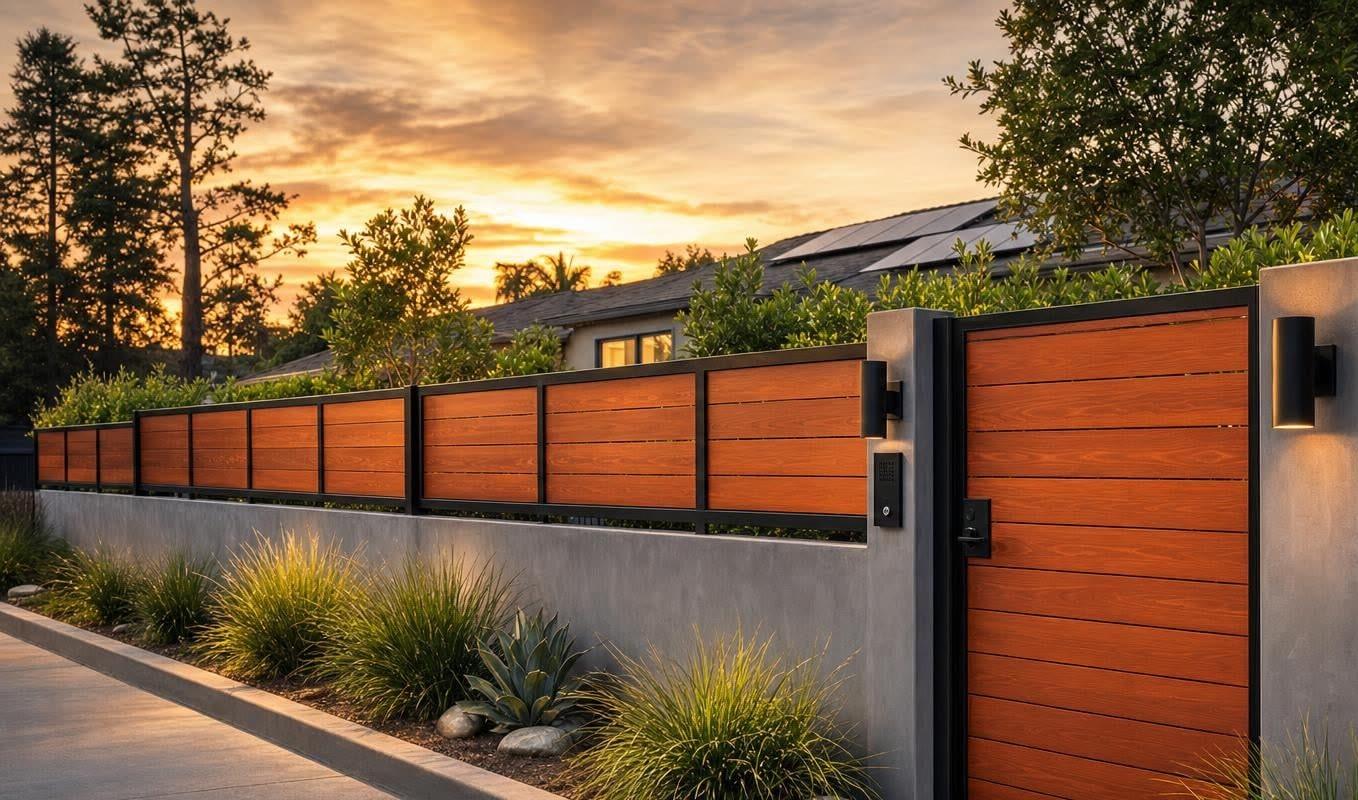
| Solid panel, steel sheet or wood cladding | Full privacy; blocks light and the street’s view of the house | Catches the most wind; the operator and any lock are sized for it | Little to grip if the street face is flush, but anyone who gets over is hidden |
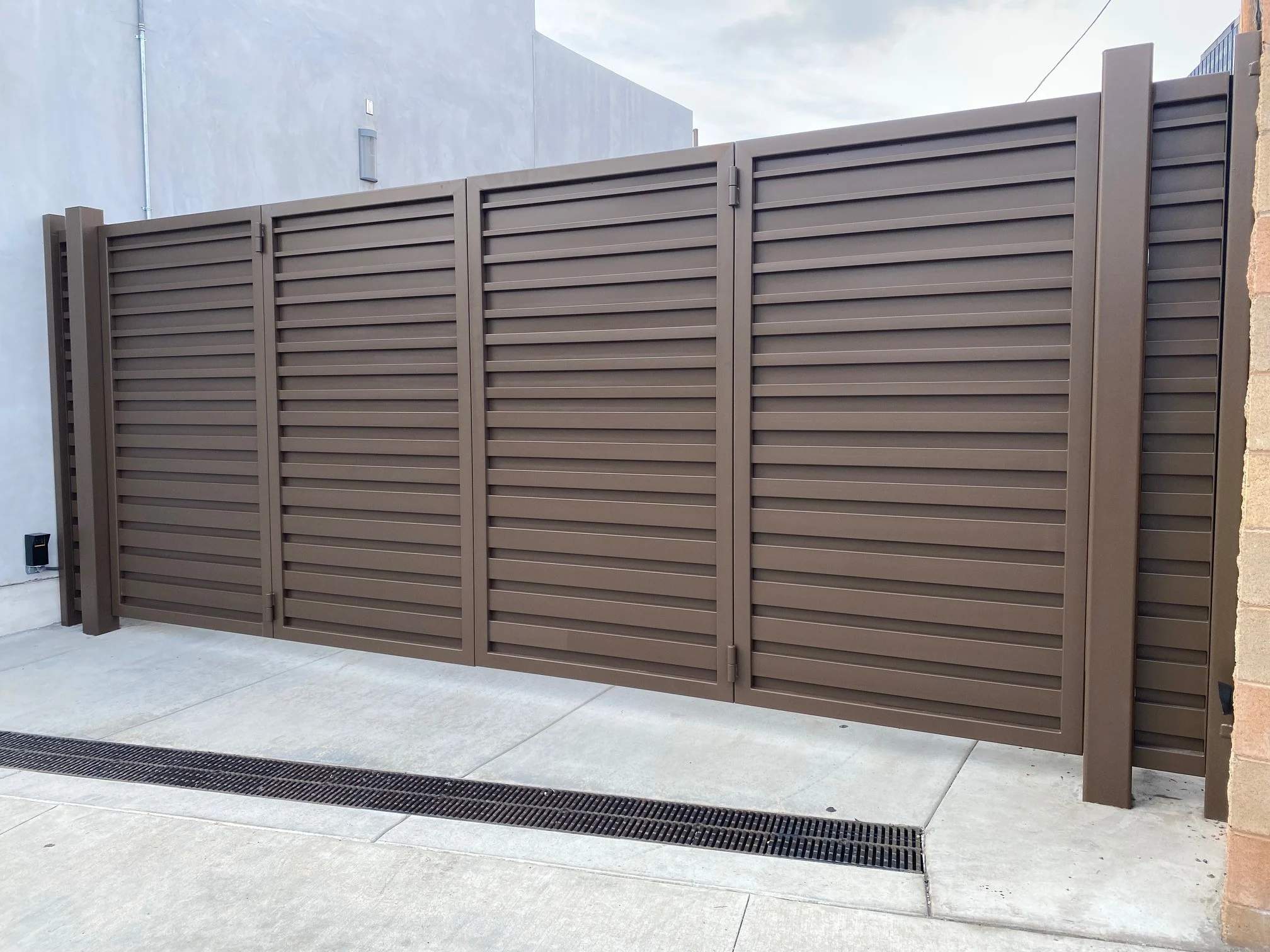
| Slats with gaps | Filters the view; more privacy as the gaps close | Lets some wind through | Vertical slats offer few footholds; horizontal slats can work as rungs |
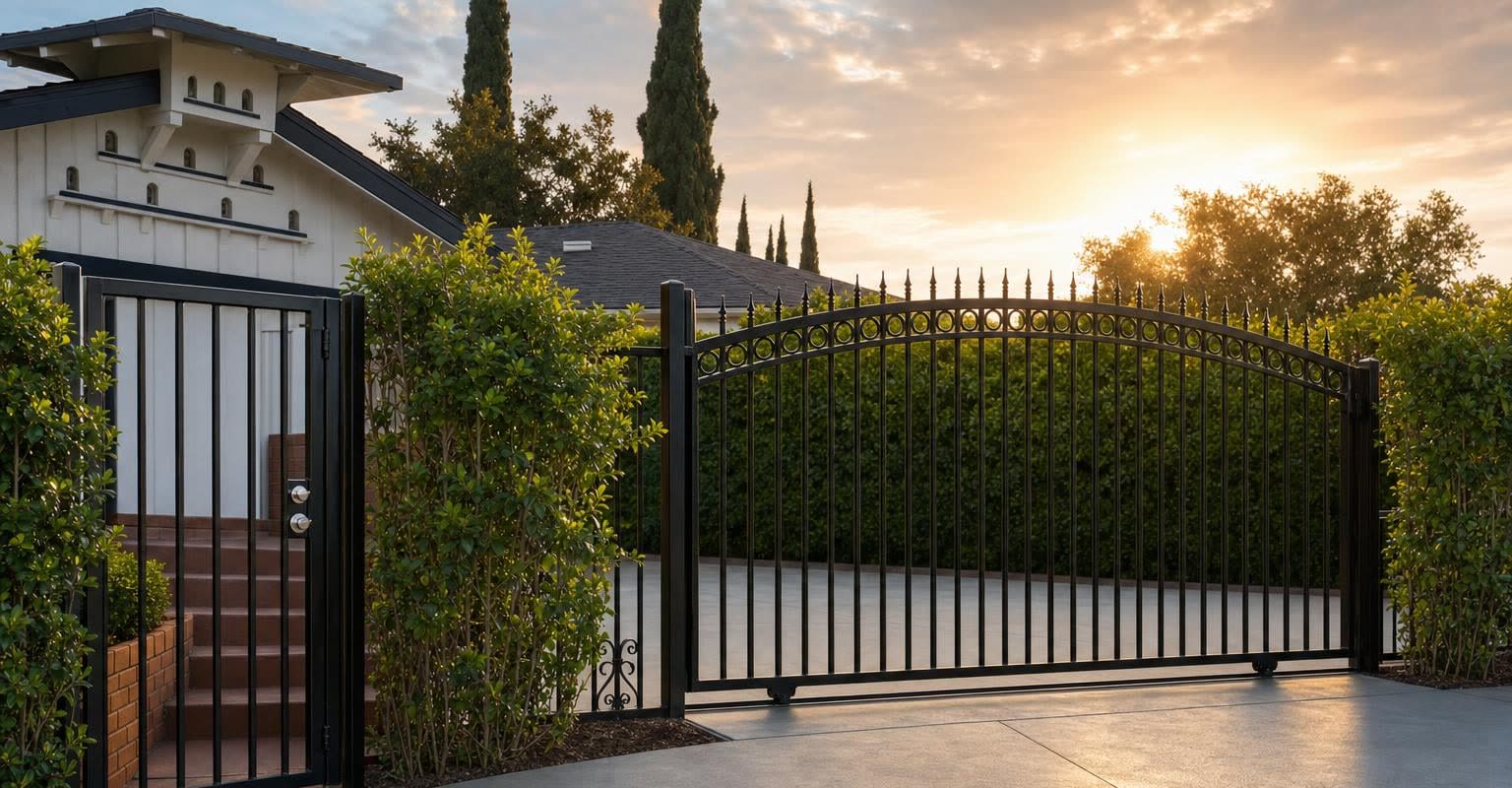
| Pickets or bars | Keeps the house in sight; least privacy | The least wind load | Hard to climb when spacing is tight and rails sit on the inside face |
Wind is the load people underestimate. A Chamberlain swing-gate drive manual warns that even light wind can make the motor safety-reverse, especially on solid panel gates, states that its size and weight limits are calculated without wind load, and calls for an electric lock with a floor lock to take the strain off the motor. Ghost Controls, which makes swing-gate openers, does not recommend its operators for full-panel gates at all, warning that a single gust can do irreparable damage to the gate and its operator. Slide gates feel it too: the DASMA rationale behind ASTM F2200 explains that wind can push a moving leaf past plumb, by an amount that varies with its surface area, length and construction.
So a privacy gate is specified as a system. DASMA’s UL 325 FAQ notes that every listed operator comes with a maximum size and weight from its manufacturer; the operator is chosen inside those limits for the leaf and its exposure, the posts and hinges are sized for the finished weight, and a lock is added where the manual calls for one. Our design guide shows how each infill reads on different houses, and custom wood gates covers solid and slatted wood faces on steel frames.
Anti-climb details for a home
A gate is hard to climb when nothing on its street side gives a hand or a foot a place to go. California’s pool barrier law puts the principle in one requirement: the outside surface of a pool enclosure must be free of protrusions, cavities and other features that would serve as handholds or footholds for a child under five (Health and Safety Code §115923). That rule governs pools, not driveways, but the same reading of a gate works for adults:
- Rails on the inside face. Horizontal rails, braces and hinge plates go on the private side, and the street face stays flush.
- Vertical members, closely spaced. Vertical pickets or slats give no rungs. On an automated slide gate the spacing is already set: UL 325’s instructions, as DASMA explains them, require each opening in a slide gate, from its bottom edge up to 6 feet or higher, to stop a 2¼-inch sphere, and the same applies to the fence the open gate covers. Swing gates are outside that screening rule, so their spacing is a design choice.
- A top that stays in the plane. Pointed pickets and finials make the top awkward to grip. On an automated gate, DASMA’s rationale for ASTM F2200 accepts decorative tops such as pickets and scrolls only where they stay within the gate’s vertical plane, so a top that curves out toward the street counts as a protrusion.
- A small gap underneath. A gap under the leaf is a way under it. DASMA’s gate safety sheet also treats a gap of more than 4 inches and less than 16 inches under a moving gate as an entrapment zone that needs protection.
- No ladders beside it. Hinge posts, operator housings, mailbox pillars, planters and trash bins next to the gate all help a climber. DASMA’s installer guidance puts the operator inside the fence line, never on the public side.
Anti-climb serves safety as well as security. DASMA lists people climbing over, under or through a gate among the situations that lead to serious injuries at automatic gates, and tells owners never to allow it. For apartment, HOA and industrial entrances the specification goes further; it is set out on our security gates page.
The gate is one part of the perimeter
A driveway gate only works if the rest of the boundary is as hard to get past, so look beside the gate as closely as at it: a lower wall next to the pillars, a side-yard walk gate with a latch you can reach through the pickets, a gap where a fence return meets the house, or a shed roof that turns a fence into a step.
- Side and walk gates. Build them to the same height and infill as the driveway gate, with hinges that close the leaf, a latch that catches on its own, and a lock nobody can open by reaching through or over. Our pedestrian gates page covers hinges, latches and electric locks.
- A walk gate for people. UL 325 requires a separate access opening for pedestrians wherever people use an automated vehicle entrance, designed to encourage its use, and DASMA adds that a pedestrian gate may not be built into the vehicle gate’s panel. That is a safety rule, and it also keeps the vehicle gate shut while someone walks in.
- Fence returns and walls. Follow the line from each pillar to the house, the garage and the neighbor’s fence, checking heights and gaps the whole way. In the City of Los Angeles, the side and rear yard limits above allow 6 or 8 feet, well over the 3½ feet of an R-zone front yard. Our fencing page covers matching runs.
- Ladders. The sheriff’s CPTED guidance below recommends keeping trees and outbuildings from giving access to roofs, balconies and upper windows; the same walk along the fence finds the low roof, woodpile or trash enclosure that gets someone over it.
Sightlines and lighting
Crime Prevention Through Environmental Design (CPTED) favors a house the street can see. The Santa Barbara County Sheriff’s Department’s residential CPTED brochure builds on natural surveillance: the front door visible from the street and the driveway with no foliage in the way, shrubs kept to 36 inches or lower and tree canopies no lower than 7 feet, and metal tubular gates and fences, or other materials that keep visibility high. The National Crime Prevention Council puts it in one line: illuminate or eliminate the places an intruder might hide, such as the spaces between trees and shrubs.
For lighting, the same brochure asks for sidewalks and every part of the yard to be lit well enough to see someone at 25 feet, suggests dusk-to-dawn lighting as an alternative to motion-triggered lights, and recommends trimming trees so they don’t block it. It also asks for the address to be visible from the street, ideally backlit, with numbers at least 5 inches high. A solid gate that hides the house makes that more important, so put the number and a light on the pillar.
This is the real trade-off of a privacy gate. A solid leaf stops the street seeing in, and it also stops the street seeing anyone who gets over it. A slatted leaf, or a solid one paired with good lighting at the pillar and a camera on the approach, gets you part of each. The brochure is careful in its own wording: CPTED may help deter crimes of opportunity. That is as much as any gate can honestly claim.
Automatic closing and entrapment protection
An automatic gate adds security only when it is closed, and it has to close safely. An operator can be set to close the gate on a timer, so it does not stand open until someone remembers the remote. Closing automatically does not change the safety rules: DASMA’s UL 325 FAQ states that the entrapment protection provisions do not depend on whether an automatic close timer is used.
Since 2016, UL 325 has required slide and swing gate operators to have two means of entrapment protection in each direction of travel before they will run, with an exception for a swing direction that has no entrapment zone. Two habits keep a gate safe and secure at once: never turn up the operator’s force to make a stiff gate close, which DASMA tells owners never to do, and keep people on the walk gate. Entrapment zones, and the devices that cover them, have their own section in our UL 325 guide, and what happens in a power outage covers the manual release, which DASMA asks installers to demonstrate at handover.
Intercom, keypad or camera at the gate
Put the controls where a driver can reach them and nobody can reach the gate. UL 325, as DASMA quotes it, puts user controls 6 feet or more from every moving part of the gate, placed so they cannot be operated through, over, under or around it, and DASMA’s installer guidance adds that the user should have a full view of the gate while operating it. An intercom or video intercom lets you answer a visitor before the gate moves; our gate openers and access control page covers keypads, remotes and visitor controls for an existing gate, and intercom and phone entry covers calling systems.
For a camera, the sheriff’s brochure recommends at least one camera angled and zoomed to record a full, clear picture of each visitor’s face, at least a quarter of the screen. At a gate, that means framing the driver’s window at the keypad and the walk gate, not the whole street. Plan the wiring before anything is paved: DASMA’s site-planning sheet asks for the conduit count, sizes and routes to be settled before trenches are dug, with power and low-voltage control wires in separate conduits, and suggests crossing the driveway under the closed gate line on swing and cantilever gates.
Questions we hear
- How tall can a driveway gate be in Los Angeles?
- In the City of Los Angeles it depends on the yard. LADBS’s bulletin caps front-yard fences at 3½ feet in R and RW zones, 6 feet in A and RA zones, or 8 feet with City Planning approval. Side and rear yards may go to 8 feet when the lot is 40 feet wide or more and not in a hillside area; otherwise the cap is 6. Other cities set their own rules; see our permit guide.
- Is a solid gate more secure than a slatted one?
- Not automatically. A flush solid leaf gives a climber little to hold, but it also hides anyone who gets over it and catches the most wind, which the operator, hinges and posts must be sized for. Law-enforcement CPTED guidance favors gates and fences the street can see through. Height, footholds, spacing and what stands beside the gate matter as much as the infill.
- Are electric gates secure?
- An electric gate controls who drives in; how hard it is to get past on foot depends on its height, infill and surroundings. It does its part when it closes behind each car, its codes and remotes are managed, and the walls and side gates beside it match it. No gate prevents crime on its own, so treat it as one layer with locks, lighting and sightlines.
- Do spikes or pointed tops help?
- Pointed pickets and finials make a top harder to grip, and on a manual gate they are mostly a matter of style. On an automated gate, DASMA’s rationale for ASTM F2200 accepts decorative tops only where they stay within the gate’s vertical plane, so tops that curve or project outward are treated as protrusions. Height and a flush street face matter at least as much.
- Does a solid privacy gate need a bigger opener?
- It needs an operator chosen for its size, weight and wind exposure, within the limits its manufacturer publishes. One Chamberlain manual says light wind can make its motor safety-reverse on solid panel gates and that its stated limits leave wind out, and Ghost Controls does not recommend its swing operators for full-panel gates. An electric lock may also be needed.
- Where should the keypad or intercom go?
- Six feet or more from every part of the gate that moves, and out of reach from the gate itself: UL 325, as DASMA quotes it, rules out any control that could be operated from over, under, around or through the gate. Put it where a driver can reach it from the car window and see the gate, with power and data run to it before the driveway is paved.
Sources
- Los Angeles Department of Building and Safety: fence heights in residential zones, Information Bulletin P/ZC 2023-002, in force since January 1, 2023: front, side and rear yard limits; City Planning approval to 8 feet; the masonry permit threshold; the sidewalk and property-line caution.
- DASMA: TDS 352, Automatic Vehicular Gate Operating Systems: Guidelines for Specifiers, Designers, Dealers, Installers and End Users (climbing as an injury hazard; controls in full view of the gate; operator inside the fence line; never overtighten the clutch; manual disconnect demonstrated at handover); TDS 356, ANSI/CAN/UL 325 and Gate Installations: Frequently Asked Questions (two means of entrapment protection in each direction since 2016; close timers; the six-foot control rule; separate pedestrian access; slide-gate screening to 6 feet; operator maximum size and weight); TDS 366, pre-installation and site planning (conduit planning; no pedestrian gate in the vehicle gate panel); TDS 370, rationale behind ASTM F2200 (decorative tops within the vertical plane; wind on moving slide gates); gate system safety sheet (the 4-to-16-inch gap under a moving gate).
- Chamberlain: TPD10-05 swing gate drive installation manual (wind load and solid panel gates; limits calculated without wind load; electric lock with floor lock). Ghost Controls: FAQ (full-panel gates and wind). Cited for their published statements only.
- California Health and Safety Code §115923 (FindLaw’s copy; the Legislature’s site refused automated reading): the outside surface of a pool enclosure free of handholds and footholds. Cited for the principle only; it governs pool barriers, not driveway gates.
- Santa Barbara County Sheriff’s Department: CPTED residential brochure (hosted by the Institute for Local Government): natural surveillance, landscaping heights, lighting to see someone at 25 feet, dusk-to-dawn lighting, visible backlit address numbers, see-through gates and fences, access from trees and outbuildings, camera framing, and CPTED described as something that may help deter crimes of opportunity.
- National Crime Prevention Council: home and neighborhood crime prevention tips: illuminate or eliminate hiding places between trees and shrubs.
- Primary sources read October 22, 2026. Height rules change by address, zone and overlay; LADBS or your city’s building and planning departments, and the operator manufacturer’s instructions, govern an actual project.
Read next
- What Makes a Driveway Gate Last: Materials, Frames, Posts, Hinges and Why Gates Sag
- Driveway Gate Design for Los Angeles Homes: Matching the Gate to the Architecture
- Los Angeles Gate & Fence Permits: Check the Address, Then the Design
- UL 325 and ASTM F2200 Explained: What a Safe, Compliant Automatic Gate Includes
- Sliding vs. Swing Driveway Gate: Which Is Right for Your Los Angeles Lot?